
Personalize Your Medication Treatments with our Pharmacogenomic Test
A simple test to help minimize side effects and maximize the efficacy of medications based on your DNA

Cliquez ici pour voir la page en français
People respond differently to medications. In some, medications can cause intolerable side effects or have no effect at all. Because of this, the process for finding the right treatment can be time-consuming and frustrating. Thanks to research in genetics, we now understand that parts of your DNA can help predict the effect of medications.
Your genetic data can assist in finding the best medication options and avoid medications that may be less compatible with your DNA, thereby speeding up your recovery. Biron’s Pharmacogenomic test can help you and your healthcare provider find the right medication and the right dose faster.
- Helps reduce trial and error, so you can feel better, faster.
- No need for blood sample: a saliva sample is sufficient to perform this test.
- Share your doctor’s information and the results will be sent directly to them.
- Your genetic results remain confidential. Only you, your doctor or someone you specifically authorize can access them.
- Our pharmacogenomic tests, covering more than 200 medications, provide personalized recommendations in the following categories:
- PGx Mental Health Test: 103 medications used to treat various mental health conditions such as ADHD, depressive disorders, anxiety, post-traumatic stress, adjustment, bipolar, and obsessive-compulsive disorders.
- PGx Pain Management Test: Over 40 medications prescribed for the treatment of acute or chronic pain.
- PGx Cardio Test: 62 medications intended for the treatment of cardiovascular diseases.
How to order the test and get your results
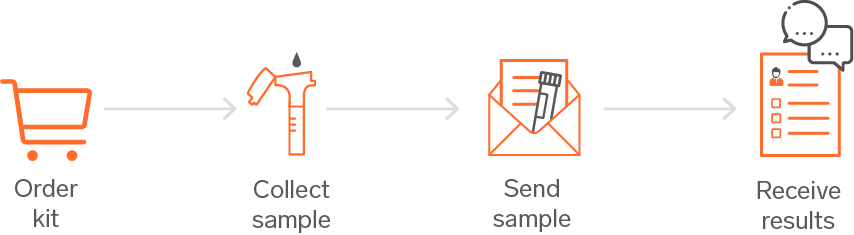
- Order your kit online. It will be delivered promptly to your home.
- All instructions for collecting the saliva sample are provided in the kit.
- Return your identified sample (and prescription, if applicable), with the provided prepaid envelope and drop it in a regular mailbox.
- Within 5 business days* of receiving the sample at our laboratory, you will receive an email to access your results.
*Expedited processing because you’re insured with Desjardins Insurance!
How can a PGx test help me?
Instead of relying solely on a traditional trial-and-error approach, our pharmacogenomic test provides your physician with a pharmacogenomic report to help guide the selection of medications among those included in the test [1-3].
Your report will help your doctor to:
- Find the right dose.
- Identify medications that may be more effective in treating your symptoms.
- Avoid medications that are more likely to cause side effects.
How can my DNA predict whether the standard dose of a medication may be too high or too low?
Metabolism is an essential step towards eliminating a medication from your body. However, metabolism can vary from one person to another, based on their DNA [4]. Watch the following video to learn more.
Frequently asked questions
Is my genetic information shared with other people or companies?
The results of our pharmacogenomic test are confidential. Your results will never be shared with a third party without your consent. In Canada, it is illegal to disclose your results to employers, insurance companies, or other service providers without your consent [5].
How long are my results valid for?
Your genetic results are good for life! In addition to helping you today, your genetic profile will not change during your lifetime. Thus, your results may be useful in the future if you need to take other medications, possibly even for medications not used to treat mental health conditions, ADHD, cardiovascular issues, and pain management.
Does this test provide information about my risk of genetic diseases?
This test does not diagnose or predict your likelihood of developing any disease or condition. Only the parts of your DNA that affect how you respond to certain medications are analyzed, in order to help optimize the treatment of a disease or condition.
What is the difference between Pharmacogenetics and Pharmacogenomics?
These two terms can be used interchangeably. They refer to the same science, but pharmacogenetics refers to the study of the impact of a specific gene on how we respond to medications, while pharmacogenomics is the broader term that studies the impact of the entire genome on response to medication.
If you have any other questions about pharmacogenomic testing, contact our team of specialists at pgxinfo@biron.com or at 1 855 943-6379.
Desjardins Insurance and its affiliates are not in any way affiliated or associated with Biron Genetics (formerly BiogeniQ) and Biron or responsible or liable for the goods or services they offer. Any data collected by Biron Genetics (formerly BiogeniQ) is governed by the terms and conditions of Biron Genetics (formerly BiogeniQ), including those relating to confidentiality, data privacy and security. Biron Genetics (formerly BiogeniQ) will not share any genetic data or test results with Desjardins Insurance.
Biron Genetics (formerly BiogeniQ) is a branch of Biron Health Group.
Desjardins Insurance refers to Desjardins Financial Security Life Assurance Company.
Desjardins®, Desjardins Insurance™ and related trademarks are trademarks of the Fédération des caisses Desjardins du Québec used under licence by Desjardins Financial Security Life Assurance Company.
200 Des Commandeurs Street, Lévis QC G6V 6R2 / 1-866-647-5013
Desjardinslifeinsurance.com
Sources5
- Oslin DW, et al. Effect of Pharmacogenomic Testing for Drug-Gene Interactions on Medication Selection and Remission of Symptoms in Major Depressive Disorder: The PRIME Care Randomized Clinical Trial. JAMA. 2022 Jul 12;328(2):151-161.
- Dunnenberger et coll. « Preemptive Clinical Pharmacogenetics Implementation: Current Programs in Five US Medical Centers», Annual Review of Pharmacology and Toxicology, 2015, 55:89-106.
- Trivedi MH et al. Evaluation of outcomes with citalopram for depression using measurement-based care in STAR D: implications for clinical practice. Am J Psychiatry. 2006;163:28–40.
- Evans and McLeod. Pharmacogenomics - drug disposition, drug targets and side effects. N Engl J Med. 2003 Feb 6;348(6):538-49.
- Genetic Non-Discrimination Act, SC 2017, c 3.