Mental Health DNA PGx Test Psychiatry and ADHD
Enhance your well-being and let your DNA guide medication choices for better mental health.
Medications do not affect everyone in the same way.
The PGx Mental Health test helps you understand how your DNA influences your response to medications. By taking this genetic test, you can enhance your chances of recovery and minimize the risk of experiencing side effects.
Additionally, the valuable information you gain can be useful for both your current medications and any future ones you may receive. With the results of your test, your doctor will have the necessary information to identify the medication and dosage that are right for you.
Which conditions is the Mental Health test designed for?
DNA testing covers relevant medications used to treat conditions and disorders affecting mental health:
- Attention deficit disorder with or without hyperactivity (ADHD) - Link to report
- Depressive disorders commonly referred to as depression
- Anxiety disorders
- Post-traumatic stress disorder
- Adjustment disorders
- Bipolar disorder
- Obsessive-compulsive disorder

When and why is a pharmacogenetic test appropriate for mental health?
The PGx Mental Health test (psychiatry and ADHD) is a relevant tool for people who meet one or more of the following criteria:
- Are taking medication(s) to treat mental health disorders and/or ADHD - Link to report
- Feel that their current medication is ineffective
- Experiencing side effects from taking medication
- Are reluctant to start treatment for fear of side effects or the perception that it won't be effective.
By taking the test, you provide your doctor with an essential tool to ensure that your prescriptions are tailored to your unique genetics. As a result, your road to recovery can be shorter and more effective.
Main categories of medication covered by the PGx Mental Health test
Wakefulness-Promoting Agents
- Modafinil (Alertec®)
- Oxcarbazepine (Trileptal®)
- Pitolisant (Wakix®)
- Solriamfetol (Sunosi®)
Central alpha-adrenergic agonists
- Clonidine (Catapres®)
- Guanfacine (Intuniv XR®)
Antidepressants
Antidepressants - SNRI
- Desvenlafaxine (Pristiq®)
- Duloxetine (Cymbalta®)
- Levomilnacipran (Fetzima®)
- Venlafaxine (Effexor XR®)
Antidepressants - SSRI
- Citalopram (Celexa®)
- Escitalopram (Cipralex®)
- Fluoxetine (Prozac®)
- Fluvoxamine (Luvox®)
- Paroxetine (Paxil®)
- Sertraline (Zoloft®)
Antidepressants - Tricyclics
- Amitriptyline (Elavil®)
- Clomipramine (Anafranil®)
- Desipramine (Norpramin®)
- Doxepine (Sinequan®)
- Imipramine (Tofranil®)
- Nortriptyline (Aventyl®)
- Trimipramine (Surmontil®)
Antidepressants - Others
- Bupropion (Wellbutrin®)
- Esketamine (Spravato®)
- Ketamine (Ketalar®)
- Mirtazapine (Remeron®)
- Trazodone (Desyrel®)
- Vilazodone (Viibryd®)
- Vortioxetine (Trintellix®)
Antipsychotics
Antipsychotics – 1st generation
- Chlorpromazine (Largactil®)
- Fluphenazine (Moditen®)
- Haloperidol (Haldol®)
- Loxapine (Loxapac®)
- Perphenazine (Trilafon®)
- Pimozide (Orap®)
- Trifluoperazine (Stelazine®)
- Zuclopenthixol (Clopixol®)
Antipsychotics – 2nd generation
- Aripiprazole (Abilify®)
- Asenapine (Saphris®)
- Brexpiprazole (Rexulti®)
- Cariprazine (Vraylar®)
- Clozapine (Clozaril®)
- Lurasidone (Latuda®)
- Olanzapine (Zyprexa®)
- Paliperidone (Invega®)
- Quetiapine (Seroquel®)
- Risperidone (Risperdal®)
- Ziprasidone (Zeldox®)
Anxiolytics
- Alprazolam (Xanax®)
- Buspirone (Buspar®)
- Bromazepam (Lectopam®)
- Chlordiazepoxide (Librium®)
- Clobazam (Frisium®)
- Clonazepam (Rivotril®)
- Clorazepate (Tranxene®)
- Diazepam (Valium®)
- Flurazepam (Dalmane®)
- Hydroxyzine (Atarax®)
- Lorazepam (Ativan®)
- Midazolam (Versed®)
- Nitrazepam (Mogadon®)
- Oxazepam (Serax®)
- Temazepam (Restoril®)
Inhibitors
Norepinephrine Reuptake Inhibitor
- Atomoxetine (Strattera®)
Monoamine Oxidase Inhibitors (MAOs)
- Moclobemide (Manerix®)
- Phénelzine (Nardil®)
- Tranylcypromine (Parnate®)
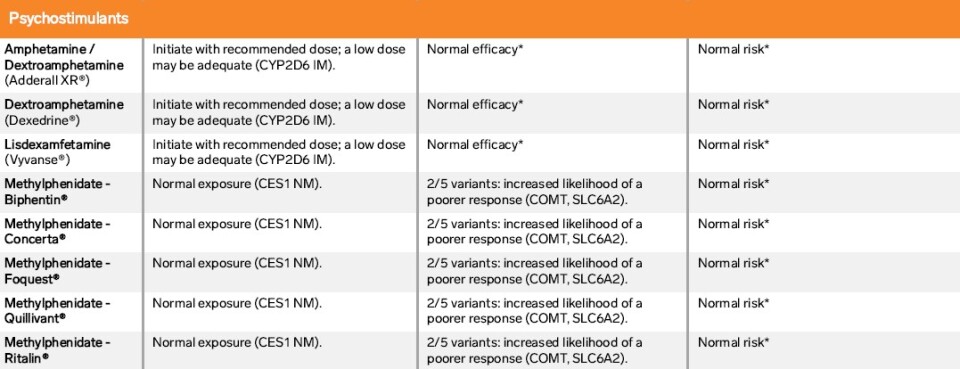
Psychostimulants
- Amphetamine/Dextroamphetamine (Adderall XR®)
- Dextroamphetamine (Dexedrine®)
- Lisdexamfetamine (Vyvanse®)
- Methylphenidate (Ritalin®, Concerta®, Biphentin®, Foquest®, Quillivant XR®)
Sedative-Hypnotics
- Diphenydramine (Benadryl®)
- Daridorexant (Quviviq®)
- Eszopiclone (Lunesta®)
- Lemborexant (Dayvigo®)
- Melatonin
- Phenobarbital (Phenobarb®)
- Triazolam (Halcion®)
- Zopiclone (Imovane®)
- Zoplidem (Sublinox®)
Mood Stabilizers
- Carbamazepine (Tegretol®)
- Gabapentin (Neurontin®)
- Lamotrigine (Lamictal®)
- Levetiracetam (Keppra®)
- Lithium (Carbolith®)
- Oxybate de sodium (Xyrem®)
- Phenytoin (Dilantin®)
- Pregabalin (Lyrica®)
- Topiramate (Topamax®)
- Valproic acid, Divalproex (Depakene®, Epival®)
Click here for the list of all medications covered.
A simple DNA test for life-changing insights!

The benefits of Biron's PGx Mental Health test
Recommendations for 103 mental health drugs

28 genes tested

A simple saliva sample is all it takes

Results in 10 working days

Consultation with a pharmacist included

Which genes are analyzed with the PGx Mental Health test?
The panel of genes tested with the Biron Mental Health test is the most extensive and the most relevant for psychiatry and ADHD, compared with other tests currently available in Canada.
The report covers medications relevant to ADHD and to conditions and disorders affecting mental health. It contains important information that your doctor can use when deciding on the best treatment for you. Our experts are available to help you and your doctor interpret the results.
| Exposure | Efficacy | Side effects |
|---|---|---|
| Should an adjustment of standard doses be considered due to a metabolic deficiency or gain of function? | Is the patient more or less likely to respond well to the treatment? | Is the patient predisposed to experiencing any particular side effects? |
| Get dose-adjustment recommendations to help achieve optimal concentrations. | Prioritize your options based on their potential effectiveness. | Understand your patient’s risks to make more informed decisions. |
How does the pharmacogenomic test work?
Collect your sample

Receive your report and a free consultation

How are test results used by healthcare professionals?
Your healthcare professional will carefully review your medication history, current medications, diagnosis, and any other relevant medical information to determine the most suitable treatment for you.
Your genetic information is a valuable complement to other medical data. Genetics alone cannot predict your response to medication with absolute certainty. In some cases, the best option for you may be a drug with a cautionary statement in your report.

Talk to your doctor about the test
Want to talk to your doctor about pharmacogenomic testing?
Download the documentation to start the conversation.

At Biron, safeguarding your privacy is our core commitment.
Ensuring the security and confidentiality of your information is a top priority for us. Your genetic data is encrypted on multiple levels and stored on Canadian servers that meet or exceed the most stringent security standards. No information is ever disclosed to third parties without your consent.
The DNA test that can change lives!
The PGx Mental Health Test is also available to
Healthcare Professionals from various specialties

Insurance companies offering disability and drug reimbursement plans

Companies that focus on employee health

Frequently asked questions about mental health and ADHD tests
Can I do the test without a prescription?
Yes, but we recommend that you ask your doctor for one. What's more, if you have a prescription, you may be exempt from paying taxes.
My doctor doesn't know about the test, but I'd like to have it done.
We will be happy to provide your doctor with relevant information regarding the test. While genetic analysis helps predict how you might respond to different medications, many other factors can also play a significant role. By having access to your results, your healthcare professional will be able to put them in context with your overall health, allowing for more informed decision-making.
Can I combine this genetic test with others?
Yes, you can combine this test with any other test offered by Biron Genetics. Make your selection in the online store to see the available options and get the best bundled price.
Is DNA testing covered by insurance plans?
Coverage for genetic testing depends on your private insurance and plan.
A prescription may be required.
If you have a Health Spending Account with your insurance plan, you may be able to use this account to cover the cost of your genetic test. We recommend that you contact your insurance company for more information on your coverage. Get a quote for your genetic test and submit it to your insurance company.
Do I have to stop taking my medication to do the test?
No. Taking any prescribed or non-prescribed medication will have no influence on the pharmacogenomic test. However, it is not advisable to stop or modify your current treatments without the approval of a healthcare professional. We therefore recommend that you continue your treatments as directed by your healthcare professional.

Avoid the lengthy process of trial and error. Order your test today.
Biron offers exclusive content on genetics.
Are you curious? Get unmatched expertise and knowledge from our experts in our Education Center.
Sources2
- Brown et al. Pharmacogenomic Testing and Depressive Symptom Remission: A Systematic Review and Meta-Analysis of Prospective, Controlled Clinical Trials (2022) Clin Pharmacol Ther
- Swen et al. A 12-gene pharmacogenetic panel to prevent adverse drug reactions: an open-label, multicentre, controlled, cluster-randomised crossover implementation study (2023) Lancet